Crime & Law
What We Know About Chicago's DNC Safety and Security Plans
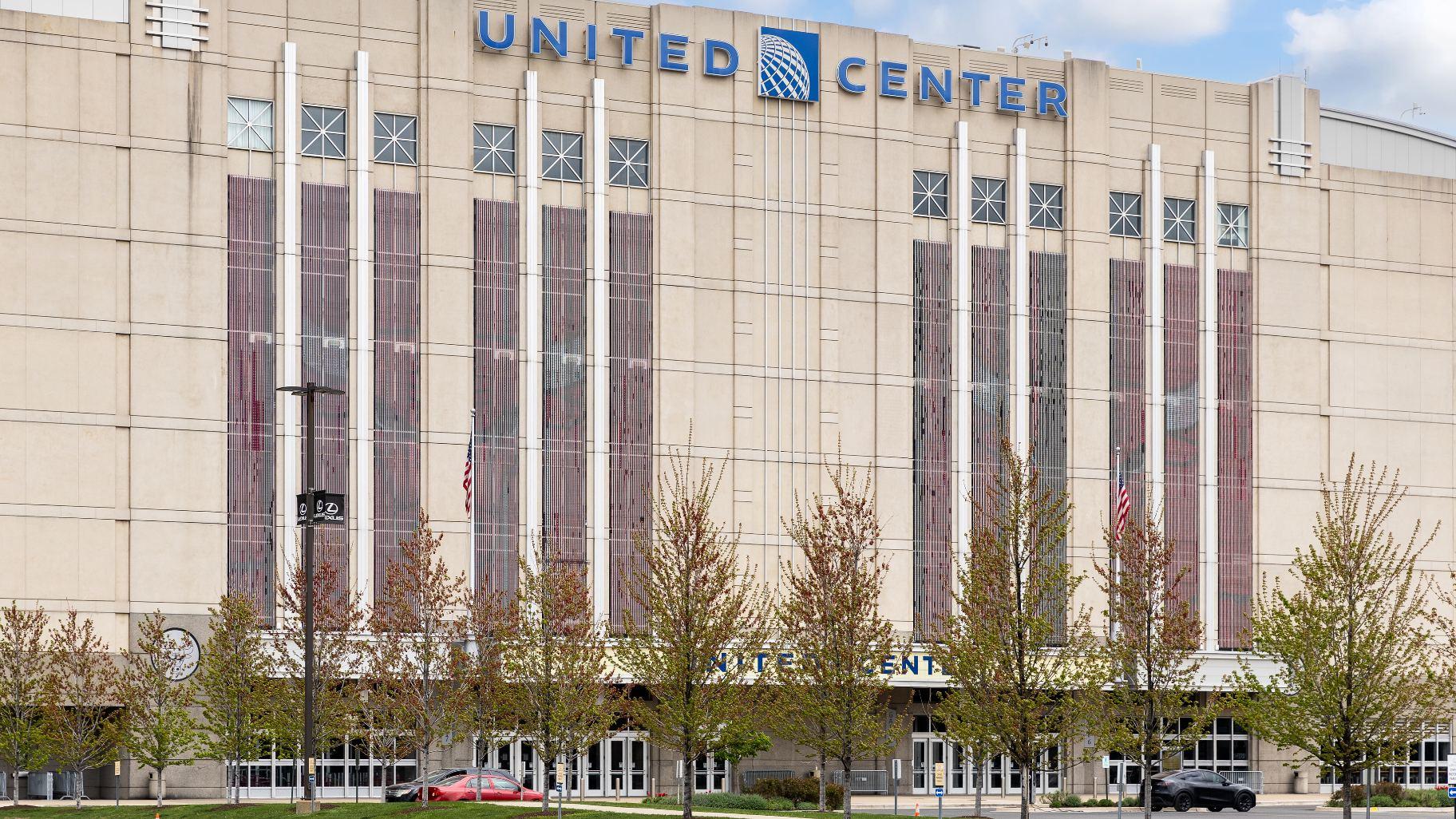 The United Center is pictured on April 24, 2024. (Joe Hendrickson / iStock)
The Democratic National Convention officially kicks off in Chicago next week and is expected to bring tens of thousands of people to the city.
In addition to the politicians, delegates, protesters and attendees come significant security risks Chicago police and other law enforcement entities must tackle to keep people safe.
“For more than a year we’ve been working together to make this a successful event,” Chicago Police Superintendent Larry Snelling said at a press conference late last month. “It has to be safe in order for it to be successful.”
With only days remaining ahead of the DNC, here’s what we know about the city’s safety and security plans.
How have Chicago police prepared for DNC security?
Snelling has said his department has worked extensively with the Secret Service and other law enforcement agencies ahead of the convention.
According to police officials, the 2,500 CPD officers who will be assigned to DNC duties will receive 48 hours of training beforehand. The department is also planning to cancel officers’ days off during the DNC as police will be working extended hours during the convention.
CPD leaders held an open training session in June, where officers practiced with riot shields, demonstrated a “line relief” — a process that will allow officers to swap out while maintaining a consistent barrier — and showed how to clear space for an ambulance or other emergency vehicles.
Chicago also sent officers to Milwaukee to assist with the security at the Republican National Convention last month.
According to Snelling, the CPD’s training is focused on officer discipline and ensuring police are working together as a cohesive unit, while also protecting protesters’ First Amendment rights.
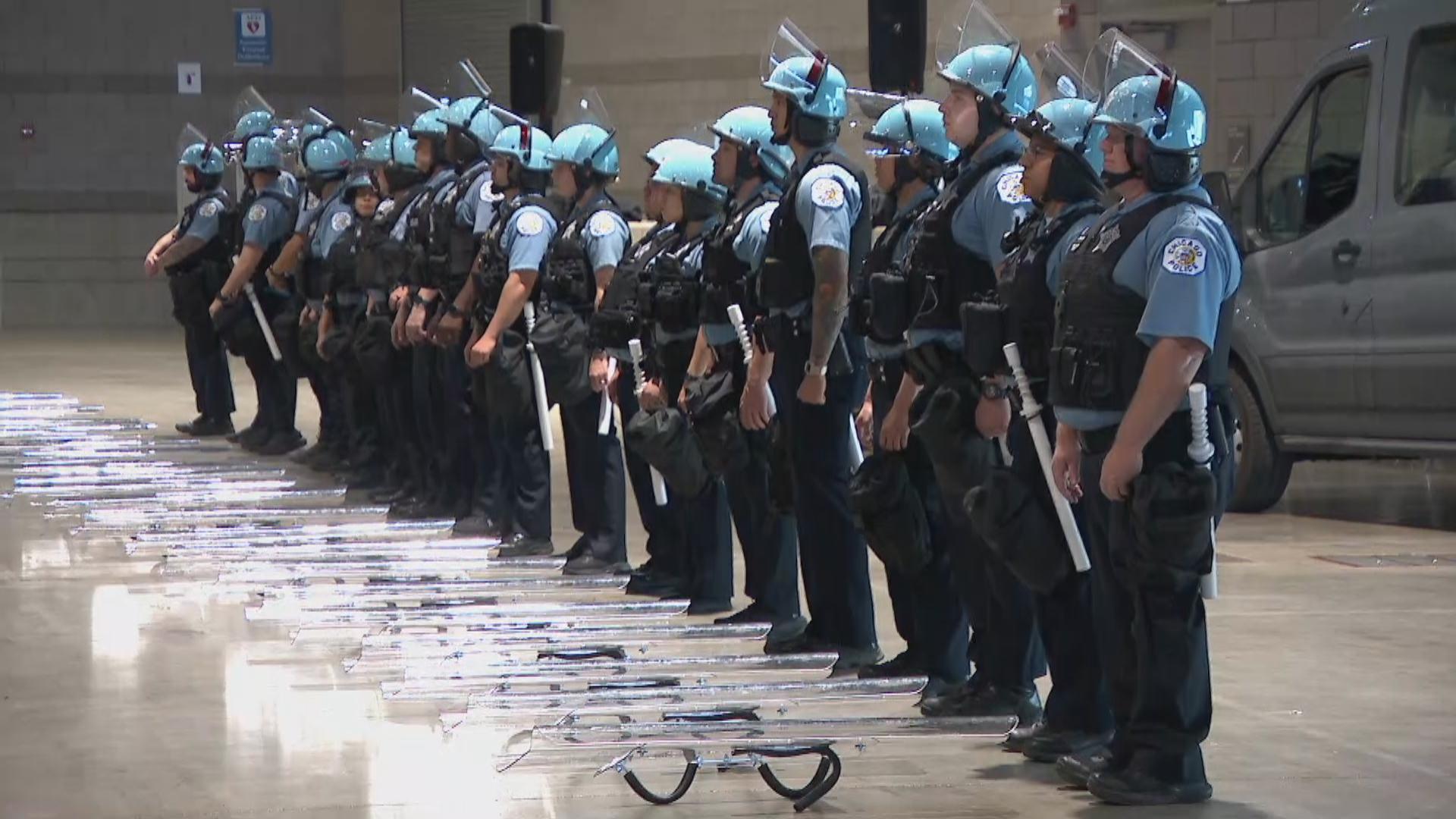 Chicago police officers training at McCormick Place on June 6, 2024, ahead of the upcoming Democratic National Convention. (WTTW News)
How will Chicago police handle protests throughout the city?
Snelling said his department has plenty of experience handling protests in the city and believes any protests during the DNC will be different than the “large scale civil unrest” seen in Chicago and elsewhere during the summer of 2020 following the police killing of George Floyd.
He said many of the 2020 protests were spontaneous, while police have had the opportunity to learn from those actions and take more time to prepare. Since last year, Snelling estimated Chicago police have dealt with more than 100 protests and have done “quite well.”
Protests during the RNC were smaller than expected — the largest of which was estimated at around 3,000 people — but groups in Chicago believe DNC protests could see up to 25,000 participants.
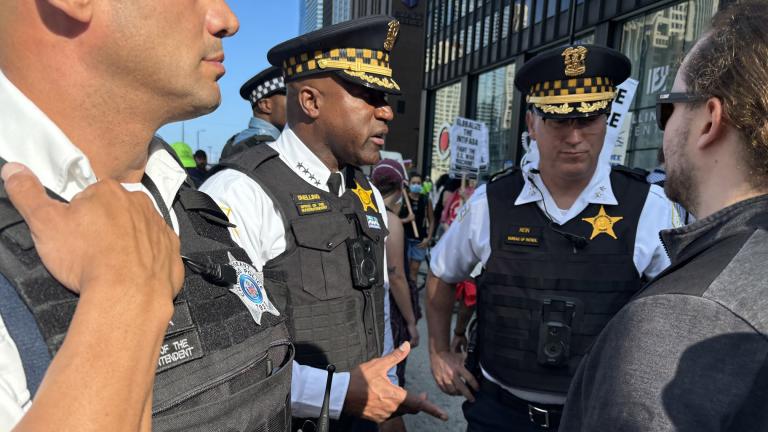
Police officials have been in regular communication with groups planning to protest the DNC, Snelling said, so all parties know what to expect during the convention.
“Our expectation is that people come here to protest and protest peacefully,” Snelling told WTTW News, “and we’re going to protect their rights to do that.”
Protesters have complained about the permitting process to secure the ability to protest during the DNC and marching routes have still not been finalized.
“We’re very happy that we have won the permit but we know it should not have come to this,” Andy Thayer of Bodies Outside of Unjust Laws said during a press conference Friday after a coalition of organizations secured their protest permit following an “eight month battle” with the city.
Will out-of-town police be working the DNC in Chicago?
Yes, Snelling expects more than 500 police officers from departments across Illinois — and Milwaukee, Wisconsin, which hosted this year’s Republican National Convention — to come to town to assist with convention security. It’s unclear how many officers, and from what specific outside departments, will be in Chicago.
During the RNC last month, officers from Columbus, Ohio, fatally shot a knife-wielding man who was involved in an altercation in a neighborhood about a mile from that convention site. Family and supporters of the man killed were critical of Milwaukee police for allowing outside officers into neighborhoods that they wouldn’t be as familiar with as local law enforcement.
CPD officials said outside officers coming to Chicago will work exclusively within the DNC security footprint, freeing up local police to handle issues in other “more volatile areas” throughout the city.
“They will be assigned to areas where we need help with infrastructure,” Snelling said during a press conference late last month. “They will not be in the neighborhoods, they will not be in areas where we know there’s a possibility that they would have to take some kind of police action.”
Out-of-town police will also receive eight to 12 hours of training of CPD policies and procedures ahead of the DNC, according to Snelling.
What’s the city’s policy on mass arrests?
The police department revised its mass arrest policy after a coalition of police reform groups behind the consent decree argued that the CPD’s existing policy violated the First Amendment.
Chicago officers now will be required to take additional steps to protect the First Amendment rights of protestors and “remain unbiased and opinion neutral in any communication with individuals within the crowd while affirming that the First Amendment rights of lawful participants are protected.”
Officers will be prohibited from arresting those engaged in First Amendment protests for “minor or petty offenses … or for actions that pose no immediate threat to the safety of the community, or others, or of causing property damage,” according to the revised policy.
Critics said the changes marked a “substantial improvement” over the original policy, but concerns remained.
Snelling said the policy is designed to make sure that any mass arrests are done in a way that focuses on the “rights of everyone.”
“We want to make sure that if we take someone into custody, we’re doing it the right way,” Snelling told WTTW News. “
Additionally, Cook County court officials have cleared the schedules of dozens of judges and opened up a temporary court facility to prepare for a possible influx of case hearings if there are any mass arrest events.
How will traffic be affected by the DNC?
Several streets around both convention sites — McCormick Place and the United Center — will be closed down beginning this weekend ahead of the DNC.
Street closures around McCormick Place begin Aug. 16 at 10 p.m. and will include:
- Indiana Avenue from 18th to East 24th Place
- Michigan Avenue from 21st to 25th Street
- Cermak Road from Wabash Avenue to MLK Drive
- 23rd Street from Wabash Avenue to Indiana Avenue
- Prairie Avenue from Cullerton Street to 24th Place
- 24th Street from Wabash Avenue to Indiana Avenue
- Calumet Avenue from Cullerton Street to 24th Place
- 24th Place from Wabash Avenue to MLK Drive
- MLK Drive from Cermak Road to 25th Street
- East 21st Street from South Michigan Avenue to South Calumet Avenue
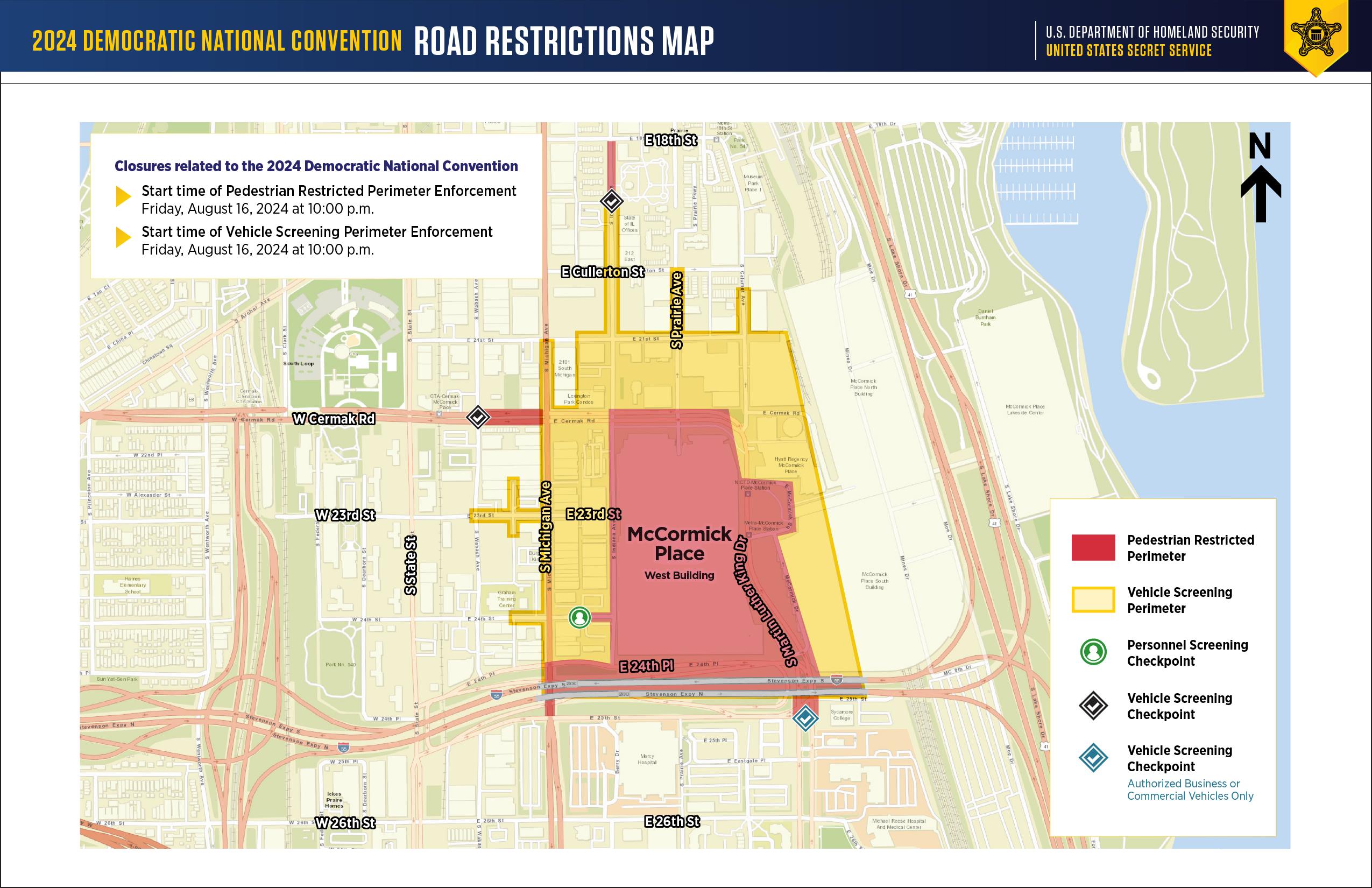 Road restrictions near McCormick Place (City of Chicago)
Street closures near the United Center will begin Aug. 17 at 7 p.m. and are set to include:
- West Washington Boulevard from Damen Avenue to South Wood Street
- Damen Avenue from Jackson Boulevard to West Washington Boulevard
- West Warren Boulevard from North Leavitt Street to South Paulina Street
- West Madison Street from North Leavitt Street to South Paulina Street
- West Monroe Street from South Seeley Avenue to South Paulina Street
- West Adams Street from South Seeley Avenue to South Paulina Street
- South Honore Street from West Monroe Street to West Adams Street
- South Wood Street from West Washington Boulevard to West Jackson Boulevard
- South Seeley Avenue from West Madison Street to West Adams Street
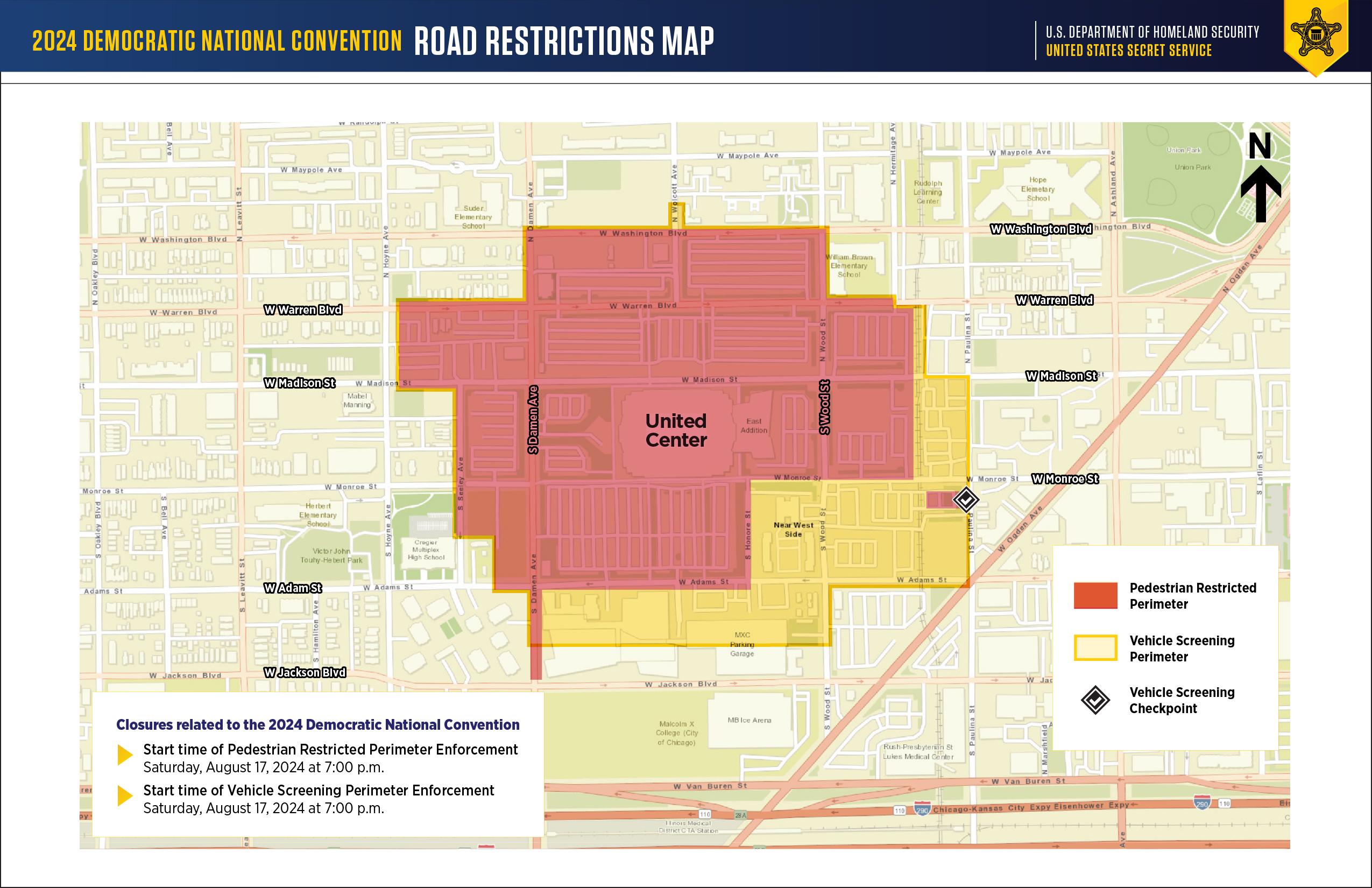 Road restrictions near the United Center (City of Chicago)
The city said an alternate route around the United Center will be available to drivers to avoid closures there, beginning on Ashland Avenue to Harrison Street to Western to Grand Avenue then back to Ashland.
Additionally, no trucks or anything larger than passenger cars will be permitted on I-55 / Stevenson Expressway between DuSable Lake Shore Drive and South State Street in both directions, according to the city.
Heather Cherone contributed to this report.